
What should you charge for this interior painting job?
Count the rooms, choose what's being painted, and set the prep and coats. The price is worked out from your own rates, line by line, and becomes a customer quote in one tap.
- 1Price the job
- 2
- 3
The job
Count the rooms you're painting. Sizes are editable in your assumptions.
Small rooms
About 10 × 10 ft
Medium rooms
About 12 × 12 ft
Large rooms
About 16 × 14 ft
Ceiling height
What's being painted
Include a surface in the job price, offer it as an add-on your customer can choose, or skip it.
Quote as
Walls
1,952 sq ft of wall
Walls
Ceilings
756 sq ft of ceiling
Ceilings
Trim & baseboards
244 linear ft of baseboard
Trim & baseboards
Doors
5 doors
Doors
Number of doors
Both sides and the frame
Condition and finish
Prep and coats change the painting time, so they change the price.
Prep
Typical repaint: patch cracks and dings, sand, spot-prime. Adds 20% to painting time.
Coats on walls and ceilings
Each coat adds paint. Coats after the first take 75% of the first coat's time.
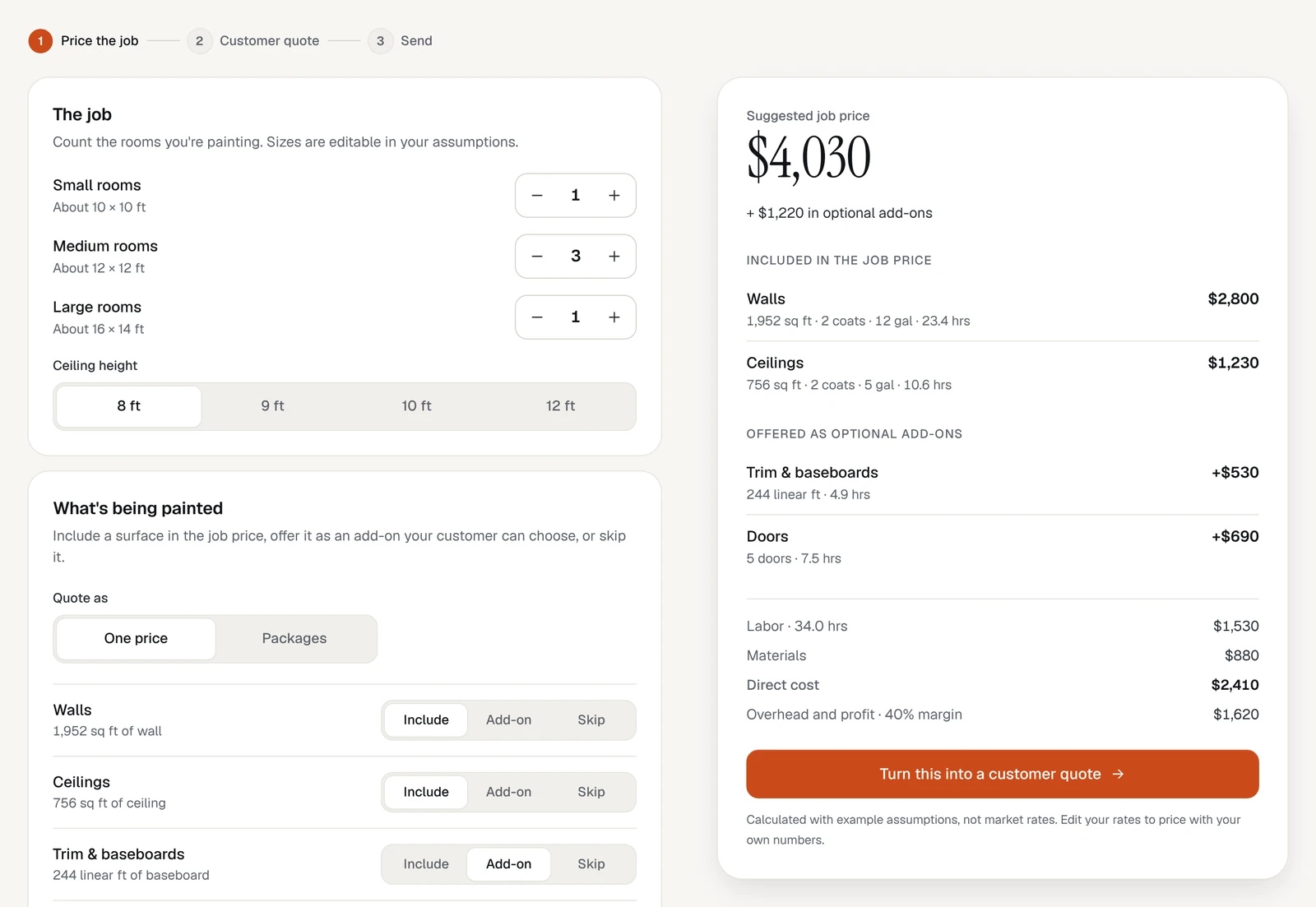
Suggested job price
$4,030
+ $1,220 in optional add-ons
Included in the job price
Walls
1,952 sq ft · 2 coats · 12 gal · 23.4 hrs
$2,800
Ceilings
756 sq ft · 2 coats · 5 gal · 10.6 hrs
$1,230
Offered as optional add-ons
Trim & baseboards
244 linear ft · 4.9 hrs
+$530
Doors
5 doors · 7.5 hrs
+$690
- Labor · 34.0 hrs
- $1,530
- Materials
- $880
- Direct cost
- $2,410
- Overhead and profit · 40% margin
- $1,620
Calculated with example assumptions, not market rates. Edit your rates to price with your own numbers.
Job price · +$1,220 add-ons
$4,030
How the calculator works
It uses the production-rate method many painting contractors estimate with: measure the work, convert it to painter-hours at your own pace, add materials, then price the cost at the margin you need.
01
Measure the surfaces
Each room size has a length and width. Walls are the room's perimeter times the ceiling height, ceilings are length times width, and baseboards run the perimeter. Doors are counted. Windows and openings aren't deducted, since cutting in around them takes time anyway.
02
Convert to painter-hours
Square feet divided by your production rate gives the hours for a first coat. Each extra coat adds a share of that time, and prep adds a percentage on top. Trim is priced by the linear foot and doors by the minute.
03
Add labor and materials
Hours times your labor cost per painter-hour is the labor. Paint is the square footage times coats, divided by coverage per gallon, rounded up to whole gallons, plus a supplies allowance. Trim and doors carry their own materials allowance.
04
Price it at your margin
The direct cost is divided by one minus your target margin, so a 40% margin keeps 40% of the price for overhead and profit. Each line rounds up to the next $10, and small jobs never go below your minimum job charge.
What changes a painting price
Each of these moves the calculated price, and the breakdown shows by how much.
- Wall area
- The biggest driver on most interior jobs. Taller ceilings add wall area in every room, which is why ceiling height is one of the first inputs.
- Prep
- Patching, sanding, and spot-priming can take as long as the painting. Light, moderate, and heavy prep add more painting time; set the percentages to match your crew.
- Coats
- Every coat needs more paint. The second and third coats usually go faster than the first, so they add a share of the first coat's time rather than all of it.
- Ceilings
- Ceiling area is about the same as the floor, and rolling overhead is usually slower than walls. Price ceilings into the job or offer them as an add-on.
- Trim and doors
- Detail work is priced by length and by count instead of area: baseboards by the linear foot, doors by the time it takes to finish both sides and the frame.
- Your margin and minimum
- Margin is not markup. A 40% margin means multiplying cost by about 1.67, not 1.4. A minimum job charge keeps small jobs worth the setup and travel.
Use your own numbers
The calculator opens with example assumptions so you can see how it works. They are not market rates, and nobody knows the right price for your area better than you. Labor cost, production rates, paint price, prep, and margin are all editable, and your numbers are remembered on this device.
The best production rates come from your own jobs: time a crew on a few rooms and divide the square feet by the hours. Compare a finished job's actual hours with the estimate, and adjust.
From price to a professional quote
When the price looks right, turn it into a customer quote. Each priced surface becomes a line in a Nearleap quote with customer-ready scope: walls included, and anything you marked as an add-on offered as an option the customer can choose.
Edit the wording, add your customer, and preview exactly what they'll see. Create a free account to send it, and the quote comes with you, exactly as you built it.
Price a job now